The short answer: Federal and Florida health sources give a window of 24 to 48 hours to dry what got wet, and the federal disaster cleanup guide says that a flooded home not dried in that time should be assumed to have mold growth. If that window has already passed, our page on mold inspection after water damage explains what an assessor looks at; this guide covers the days before that.
Juniper Tide Mold Referrals is a referral service, not a mold company. The timing and health statements below come from the EPA, the CDC and the Florida Department of Health, each named where it is used and listed with its date at the end.
The 24 to 48 hour window
The U.S. Environmental Protection Agency (EPA) puts the number near the top of its Brief Guide to Mold, Moisture and Your Home: it is important to dry water damaged areas and items within 24 to 48 hours to prevent mold growth. The same guide says to "Fix plumbing leaks and other water problems as soon as possible," and both steps come before any inspection.
| EPA, Brief Guide | Dried 24 to 48 hours after a leak or spill: in most cases, the EPA says, mold will not grow. |
|---|---|
| CDC, Mold page | After a flood, the CDC says to clean up and dry out the home fully and quickly, within 24 to 48 hours. |
| Florida Department of Health | Common molds can take hold when water stands for even 24 hours, the department says. |
| Federal disaster cleanup guide | A flooded home not dried within 24 to 48 hours, furniture and other items included: assume mold growth. |
Why water starts the clock
The Florida Department of Health lists three things mold needs to grow and multiply: nutrients, a suitable place to grow, and moisture.
A home already holds the first two. The department names wood and sheetrock as building materials that provide food for mold, and says even dust settled on them can feed it.
Moisture is what the water adds. The department's own summary is short: water is the key.
Florida's 24 hour mark
The Florida Department of Health uses the short end of the window. Among its prevention steps, it says to clean and dry up spills within 24 hours and to dry out wet building materials and carpets within 24 hours.
Past 48 hours
The EPA's water damage table treats 48 hours as a guideline, not a hard line. A note under it says mold growth may have occurred even if materials are dried within 48 hours, and that growth will not always occur after 48 hours.
How long until mold shows
None of these agency pages gives a number of days before mold becomes visible, so this guide does not give one.
Flood, roof leak, pipe leak or hurricane
The CDC's mold page names the same places this section covers. It says mold will grow where there is moisture, such as around leaks in roofs, windows or pipes, or where there has been a flood.
Mold after a flood
The Florida Department of Health lists flooding from outside, such as storm water, overflowing lakes, streams and storm surge, among the sources of indoor moisture. It also lists indoor flooding from sinks, tubs, toilets, air conditioner drain pans or sewerage systems.
The federal disaster cleanup guide warns that flood water may have carried sewage or chemicals into your home. The EPA's mold course says buildings heavily damaged by flood waters should be assessed for structural integrity and remediated by experienced professionals.
Clean water and flood water
The EPA's drying guidelines were written for clean water. Its mold course says they were not developed for flood water, sewage or other contaminated water.
Mold after a roof leak
The EPA's Brief Guide lists roof materials above ceiling tiles, due to roof leaks or insufficient insulation, among the places mold may hide.
Given time, the damage goes deeper. The EPA's mold course says that if a roof is allowed to leak long enough, molds can weaken floors and walls by feeding on the wet wood.
Mold after a pipe leak
The Florida Department of Health lists indoor plumbing leaks and broken water pipes as a source of moisture. The EPA's Brief Guide names areas inside walls around leaking or condensing pipes as a possible location of hidden mold.
For a pipe leak, the EPA's advice quoted above applies: fix the leak first, then dry all items completely.
Mold after a hurricane
A hurricane can bring more than one of the water sources above at the same time. On its hurricane recovery page, the EPA says that after the flood you should remove standing water and dry indoor areas, and remove and discard anything that has been wet for more than 24 to 48 hours.
Generators during an outage
Drying often waits on power. The EPA's hurricane page warns that generator exhaust is toxic and says never to use a generator inside homes, garages, crawlspaces, sheds or similar areas.
The federal disaster cleanup guide says to use portable generators outside and at least 20 feet away from buildings.
The first days, step by step
The steps here come from the Homeowner's and Renter's Guide to Mold Cleanup After Disasters, a federal guide the EPA hosts and the Florida Department of Health links from its mold page. We repeat them closely and add nothing of our own.
Before going back inside
The guide says you and your family should wait to re-enter your home until professionals tell you it is safe, with no structural, electrical or other hazards.
The disaster cleanup guide puts a call to your insurance company before cleanup starts; what a policy covers is a question for your insurer, and our guide Does homeowners insurance cover mold in a Florida home? collects what official sources say.
People the guide says should stay away
The guide says people with breathing problems like asthma, or with weakened immune systems, should stay away from moldy sites, and that children should not take part in disaster cleanup work.
For anyone who does go in, it says to wear an N-95 respirator at a minimum, goggles and protective gloves.
The guide's drying steps
The guide calls drying your home and removing water damaged items your most important step for preventing mold damage. It lists the work in this order:
- Take out standing water and wet materials, using a wet vacuum on floors, carpets and hard surfaces, and dry everything as quickly as you can, within 24 to 48 hours if you can.
- Open doors and windows while you work, inside doors too, especially closets and interior rooms, so air reaches every area.
- Open the attic access so air can flow there, after making sure nothing will fall on you.
- Open kitchen cabinets and bathroom vanities, take out the drawers, wipe them clean and stack them to dry.
- Once electricity is safe to use, run fans and dehumidifiers to remove moisture.
- Throw away anything wet with flood water that cannot be cleaned and dried completely in that time.
The same guide puts a limit on fans: do not use them if mold has already started to grow, because they may spread it.
Wet materials, one by one
The EPA's Table 1 sets out what to do with each wet material in that window. It was written for schools and commercial buildings, and the EPA's Brief Guide says that document is applicable to other building types.
| Carpet and backing | Dry within 24 to 48 hours with a water extraction vacuum, a dehumidifier and fans. The subfloor beneath must also be cleaned and dried. |
|---|---|
| Drywall (wallboard) | Can be dried in place when there is no obvious swelling and the seams are intact; otherwise remove, discard and replace. Ventilate the wall cavity if possible. |
| Ceiling tiles, cellulose or fiberglass insulation | Discard and replace. |
| Linoleum, ceramic tile or vinyl floors | Vacuum or damp wipe with water and mild detergent and allow to dry. Check that the underflooring is dry. |
| Wood surfaces and paneling | Remove moisture right away and dry with dehumidifiers, gentle heat and fans. Pry wet paneling away from the wall to dry. |
| Books and papers | Discard items that are not valuable; photocopy valuable ones, or freeze or freeze dry them. |
A table for clean water
The EPA says the table is for damage caused by clean water. Where the water may hold sewage or chemical or biological pollutants, it says not to use fans before determining that the water is clean or sanitary.
The air conditioner
The EPA's Brief Guide says not to run the heating and air conditioning system if you know or suspect that it is contaminated with mold, because it could spread mold throughout the building.
The Florida Department of Health notes that stopping air conditioning would make most Florida buildings very uncomfortable in hot and humid weather. Its answer is that, ideally, the system should be shut down while cleaning or mold removal is performed.
What the guides say does not work
- Paint or caulk on top of mold: the federal disaster cleanup guide says this will not prevent mold from growing.
- Ozone generators: asked whether to use one, the Florida Department of Health answers no, because ozone irritates lungs and is not likely to be effective at addressing an indoor mold problem.
- Bleach as the fix: the department says using bleach or other chemicals to kill indoor mold growth is not needed in most cases, and that the goal should be to remove the growth.
- Cleaning without fixing the leak: the EPA says that if the water problem is not fixed, the mold problem will most likely come back.
Signs of mold after water damage
The Florida Department of Health says indoor mold growth can usually be seen or smelled.
Growth you can see
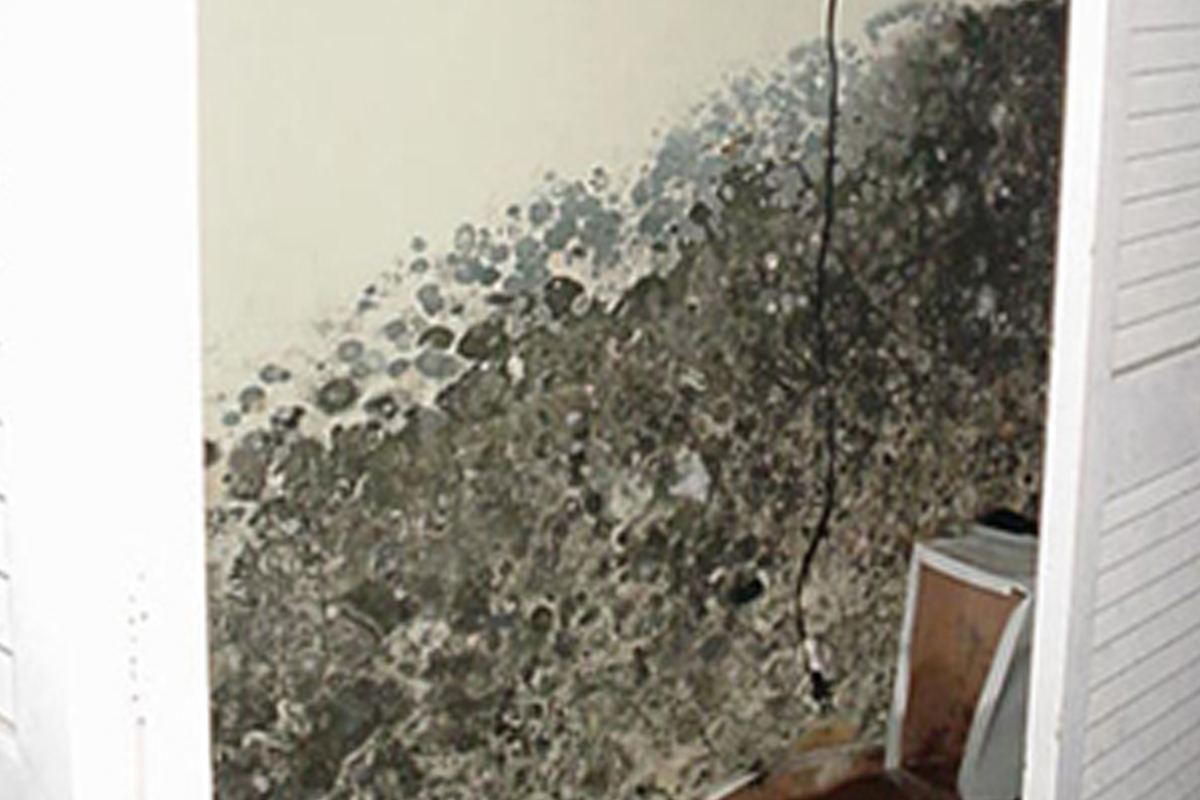
In the department's description, mold may look cottony, velvety, rough or leathery, and may be white, gray, brown, black, yellow or green. It often shows as staining or fuzzy growth on furniture, walls, ceilings or anything made of wood or paper.
The department also points to signs of moisture or water damage: water leaks, standing water, water stains and condensation.
A smell with no source
The department says an earthy or musty odor may mean you have a mold problem. The EPA says you may suspect hidden mold if a building smells moldy but you cannot see the source, or if there has been water damage and residents report health problems.
Where hidden mold sits
The EPA's Brief Guide lists places where mold after water damage can stay out of sight:
- The back side of drywall, wallpaper or paneling
- The top side of ceiling tiles
- The underside of carpets and pads
- Inside walls around leaking or condensing pipes
- Inside ductwork
- Roof materials above ceiling tiles
Why the EPA urges caution when looking
The EPA says investigating hidden mold requires caution when it means disturbing places where mold may be growing. Its example: removing wallpaper can lead to a massive release of spores if mold is growing on the underside of the paper.
When the guides point to a professional
Each situation below is named in an official source as a reason to bring in someone with experience.
- A musty smell you cannot trace. The EPA says that if you believe you have a hidden mold problem, consider hiring an experienced professional.
- Sewage or other dirty water. The EPA and the Florida Department of Health both say to call a professional who has experience cleaning and fixing buildings damaged by contaminated water.
- A large area. The EPA's Brief Guide points to its schools and commercial buildings guidance when there has been a lot of water damage or a large area is moldy.
- A job too big to do safely. The federal disaster cleanup guide says the job may be too difficult or dangerous for you, and that it may be best to get help from experienced and qualified professionals if you can.
Whether testing is needed
The federal disaster cleanup guide says sampling for mold is not usually recommended, and that whatever kind of mold is in your home, you need to clean it up and fix the moisture problem. The CDC also says it does not recommend mold testing.
Who licenses mold work in Florida
The Florida Department of Business and Professional Regulation licenses mold assessors and mold remediators. Our guide to Florida mold license rules covers the two license types.
How this site fits in
Juniper Tide Mold Referrals does not inspect, test or remove mold. We take requests for homes in Jacksonville and Jacksonville Beach, and we may pass one to an independent company whose mold assessor holds a Florida license; that company may pay us for the introduction.
For a Jacksonville Beach home, see mold inspection in Jacksonville Beach; both places are on our areas served page.
Mold After Water Damage: Questions Readers Ask
How long does it take mold to start after water damage?
The Florida Department of Health says common molds can take hold when water stands for even 24 hours. The EPA and the CDC use the longer drying window set out in the table above.
Does a wet wall have to come out?
Not always, according to the EPA's water damage table. It says wallboard may be dried in place if there is no obvious swelling and the seams are intact, and that otherwise it should be removed, discarded and replaced. The same table lists wet cellulose and fiberglass insulation as discard and replace.
How do I know a cleanup is finished?
The federal disaster cleanup guide says that if you still see or smell mold, you have more work to do, and that after a remediation there should be no signs of water damage or mold growth. The EPA's Brief Guide adds that the water or moisture problem must be completely fixed before a cleanup can be considered finished. It also calls the final decision a judgment call with no easy answer.
Can mold damage the house itself?
The EPA's mold course says that because mold digests what it grows on, it can damage a building and its furnishings, and that left unchecked it can eventually cause structural damage. When mold is suspected of harming a building's structural integrity, the course says a structural engineer or other professional with relevant expertise should be consulted.
Sources
- U.S. Environmental Protection Agency, A Brief Guide to Mold, Moisture and Your Home. https://www.epa.gov/mold/brief-guide-mold-moisture-and-your-home. Read 2026-11-22.
- U.S. Environmental Protection Agency, Mold Course Chapter 2. https://www.epa.gov/mold/mold-course-chapter-2. Read 2026-11-22.
- U.S. Environmental Protection Agency, Mold Remediation in Schools and Commercial Buildings, Chapter 4 (Table 1: Water Damage, Cleanup and Mold Prevention). https://www.epa.gov/mold/mold-remediation-schools-and-commercial-buildings-guide-chapter-4. Read 2026-11-22.
- Homeowner's and Renter's Guide to Mold Cleanup After Disasters (June 2015), hosted by the U.S. Environmental Protection Agency. https://www.epa.gov/sites/default/files/2017-08/documents/mold._homeowners_and_renters_guide_to_cleanup_after_disasters.pdf. Read 2026-11-22.
- U.S. Environmental Protection Agency, Hurricanes. https://www.epa.gov/natural-disasters/hurricanes. Read 2026-11-22.
- Centers for Disease Control and Prevention, Mold (September 26, 2024). https://www.cdc.gov/mold-health/about/index.html. Read 2026-11-22.
- Florida Department of Health, Indoor Mold and Your Health. https://www.floridahealth.gov/community-environmental-public-health/environmental-public-health/air-quality/mold/. Read 2026-11-22.
- Florida Department of Business and Professional Regulation, Mold-Related Services. https://www2.myfloridalicense.com/mold-related-services/. Read 2026-11-22.
Related page
Mold inspection after water damage: what a Florida licensed mold assessor looks at once a leak, a storm or a flood has passed.
Other guides
What goes into a mold inspection quote and Does homeowners insurance cover mold in a Florida home?
How to ask
Send a request through the short form on the contact page. A company whose mold assessor holds a Florida license may receive it, and it may pay us for the introduction.